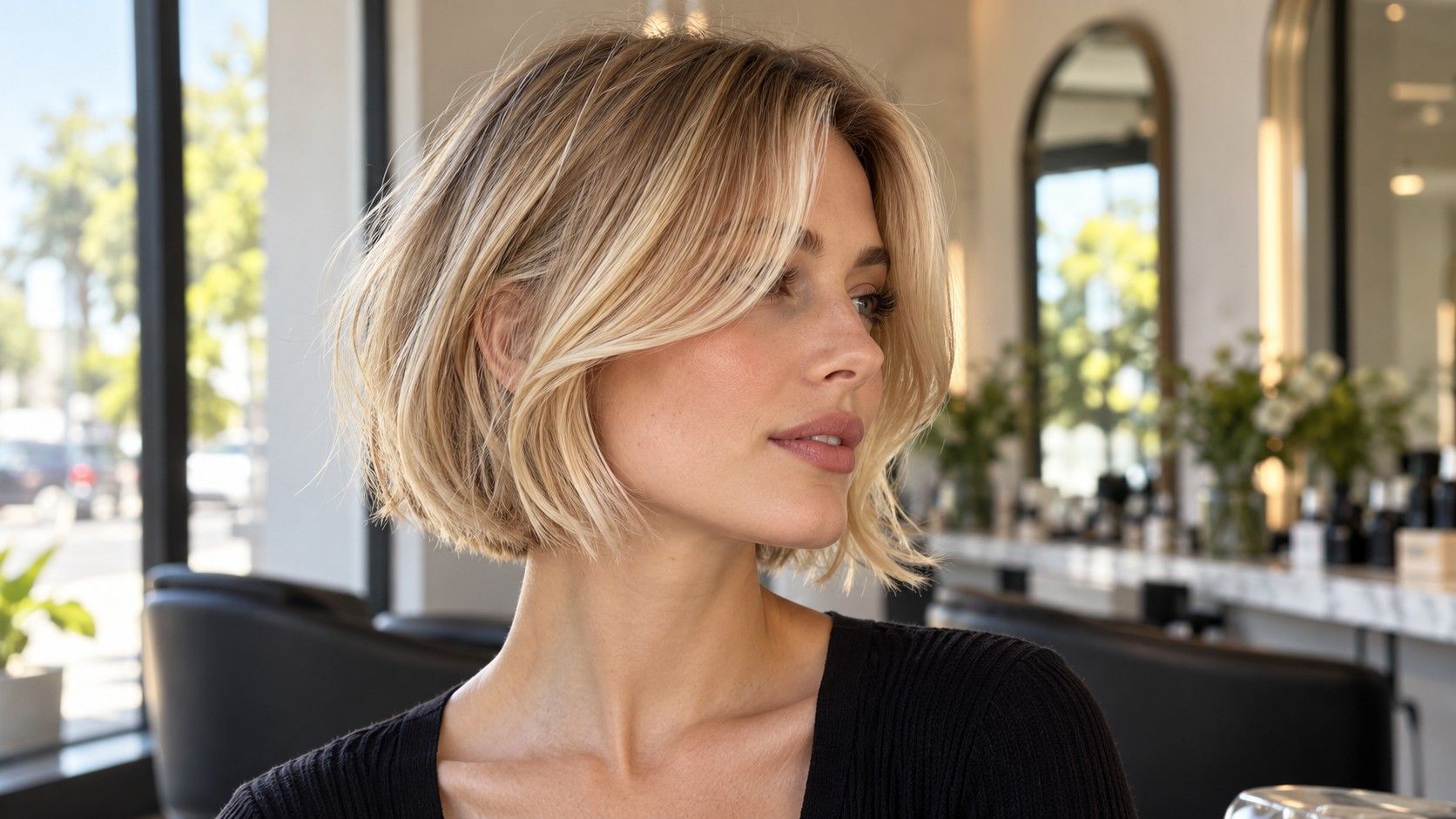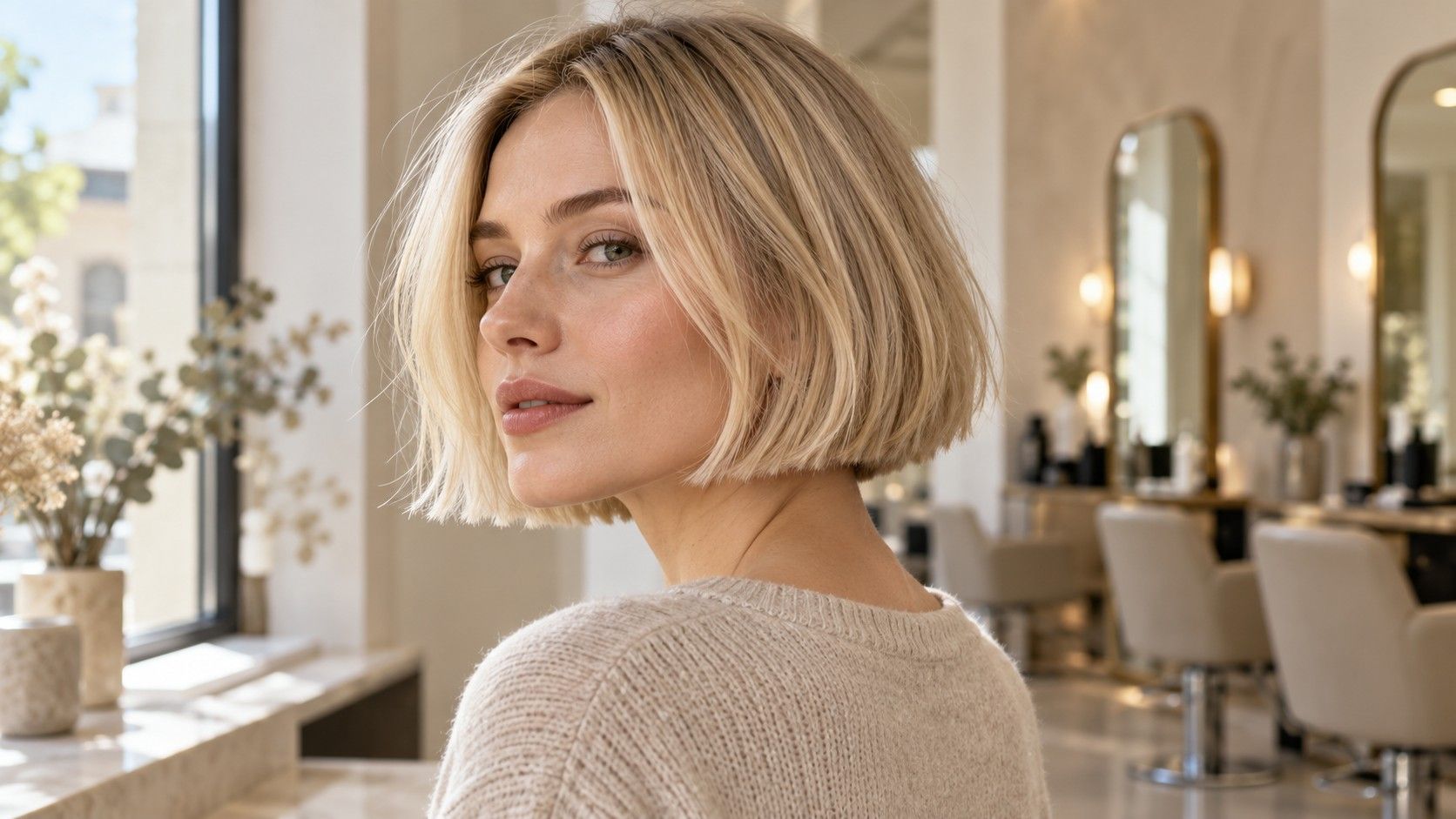
A blonde bob can look crisp and graphic in one photograph and soft and airy in another. The shade may be similar; the difference is often where the ends sit, how much weight remains inside the cut and how the hair has been styled. Before choosing an icy or golden reference, work out which outline you want to see in the mirror on an ordinary morning. That gives your stylist something more useful than a photograph of someone else's color.
Find the length that works when you move
Start by placing a finger at three possible finishing points: just below the cheekbone, around the jaw and between the jaw and shoulders. Look straight ahead, turn sideways and lower your chin. These are reference points rather than rules about which face deserves which haircut. A jaw-length edge may create the strong horizontal line you want; a slightly longer front may feel easier if you like to tuck your hair away while working.
Check the back as carefully as the front. A bob that clears the collar in a portrait can touch a high coat collar when your head tilts. Ends that meet the shoulder may turn outward, particularly when the hair already bends there. That can be an appealing part of the shape. If you want a still, straight perimeter, ask whether moving the length a little higher or lower would make your routine easier.
Hair in a reference photo may have been stretched during drying. With waves or curls, discuss the intended finished length in its usual dry state. There is no reliable universal allowance for shrinkage. Bring a picture of your own hair after air drying, including any uneven movement around the ears. It helps explain why two sides that measure the same can appear to finish at different heights.
Choose the edge before asking for more texture
A blunt perimeter keeps a clear line through the ends. On hair with limited density, retaining that line may make the bottom look more substantial. It does not require every strand inside the cut to be identical in length. A stylist can discuss internal shaping while preserving the visible edge. Ask to see where the weight would be removed, rather than treating “layers” as one single haircut.
Soft ends interrupt the line and can give a bob a less exact finish. The tradeoff is visibility: pale ends against a light shirt may already look delicate, so removing more weight can leave them looking thinner than expected. Compare references with similar lighting and backgrounds. A dark top makes the outline easier to inspect than a white salon cape under bright lights.
| Shape choice | What to inspect | Question for the consultation |
|---|---|---|
| Blunt edge | Continuity of the bottom line at the sides | Can the perimeter stay full with my density? |
| Soft internal shaping | Movement through the middle without sparse ends | Where would you remove weight? |
| Graduated back | Profile and height of the weight at the nape | How will this sit as the back grows? |
| Longer front | Difference between the front and back lengths | Will the front still tuck behind my ears? |
Graduation deserves its own conversation. A rounded, lifted back is different from a bob with a level, low perimeter. Side and rear views reveal that difference much better than a front-facing selfie. If you dislike a pronounced stacked shape, say so explicitly and show a profile you do like.
Check where your hair is dense, flat or restless
Overall labels such as “fine” or “thick” leave out useful information. Fine strands can grow densely, and a dense back can sit beside thinner temples. Part the hair in its usual place and look at the areas above the ears. Those side sections have to travel around the head before reaching the perimeter. Removing substantial weight there can change the apparent fullness of the front.
At the nape, notice whether short hairs lie down, turn sideways or lift away from the neck. A very short back exposes that behavior. Keeping a little more length may change how it sits, but a haircut cannot promise to erase a growth pattern. Ask your stylist to examine the nape before agreeing to the shortest photograph in your collection.
For a bob worn with waves, inspect the outline without separating every curl for the camera. A large amount of weight low down can produce a wider lower shape; extensive layering can produce a different silhouette and more individual ends. Decide whether you prefer a compact outline, visible movement or volume higher up. These preferences are more actionable than asking for a cut that is simply “flattering.”
Also bring up your parting habits. A deep side part can shift fullness toward one side and expose the opposite temple. A center-parted reference may therefore look quite different on you even before color enters the discussion. Have the stylist assess the cut with the part you actually expect to wear.
Plan blonde placement around the finished haircut
Once the outline is clear, decide which parts of it you want the blonde to emphasize. Lighter pieces near the face can draw attention to a longer front. A more continuous pale finish can make a blunt line look graphic. Deeper areas underneath may create visible contrast as the hair moves. None of these effects requires choosing a named color technique before your consultation.
Show the colorist the intended cut and discuss the sequence of the appointment. A major length change may remove much of the lighter hair already at your ends. Placement chosen for longer hair may land differently after the cut. For a bob with a shorter back, ask how the color will look when viewed from behind and when the sides are tucked.
A root area close to your natural depth can soften the visible transition as hair grows, depending on the placement and contrast. It does not make blonde maintenance disappear. Ask what the planned result will look like after some regrowth, which appointments are for shape and which are for color. Obtain an estimate based on your current hair and desired result rather than a price inferred from a photograph.
Keep brightness and tone separate in the conversation. You might like the lightness of one photo but prefer the warmer appearance of another. Screens, lighting and filters can shift both. Describe the feature you mean, and let the colorist assess what is realistic for your existing color history and condition. A photograph is a reference, not a guarantee of an identical result.
Test the bob against your real morning routine
Choose a reference that resembles the finish you are prepared to create. A smooth bob with the ends curved inward may require directed drying on hair that usually bends outward. A tousled bob may still have been carefully styled. Ask how the proposed cut is likely to sit after your usual drying method, and what additional work would produce the photographed finish.
Think through specific moments: wearing glasses, placing headphones over your ears, walking in wind and tying hair back for exercise. A short bob may tuck neatly when still and then fall forward as soon as you move. If tying it up is essential, explain what that means. A tiny gathered section at the back is different from being able to secure all the sides.
Before leaving the salon, watch the finishing sequence and ask which part controls the shape. It may be the direction of drying at a parting or the way the front is allowed to cool. Request a routine that matches your time and tools. Do not commit to a daily polished finish if you mainly want to wash your hair and let it settle.
Bring a clear description with a front, side and back view
Two or three coherent references are usually easier to discuss than a large folder of unrelated bobs. For each photo, identify one reason you saved it: the length at the jaw, the fullness at the ends, the softly rounded back or the color near the face. Include one example of a detail you want to avoid. The stylist can then separate a preference about shape from a preference about styling.
A useful description might read: “I want a blonde bob below my jaw, with enough length to tuck the front behind my ears. Keep the bottom looking substantial. I prefer a soft bend to a perfectly straight finish, and I usually air dry.” Add any previous color work and the time you can spend between appointments. This leaves room for professional assessment while making your priorities clear.
Finally, agree on the shortest point before cutting begins, and ask to see that point in the mirror. Discuss how the shape is expected to change with growth and what signs mean it needs a trim. The best reference is the one that helps you make those decisions, even if its blonde shade is not the shade you ultimately choose.